Political Theory — Power Analysis
Noumenal Power, Democratic Legitimacy, and the Otto Quangel Condition
This paper argues that Rainer Forst's concept of noumenal power, though subject to substantive objections from McNay, Lukes and Hayward, is neither invalid or insufficient on its own. Each objection identifies a structural gap — the absence of a reflexive grounding, the pre-cognitive occupation of the space of reasons, and the extra-discursive force of institutionalised conditions — that points toward the same response. The paper proposes a triadic model of power comprising three mutually constitutive dimensions: capacitive power (the positive ability to act, deliberate and form reasons), dominating power (the structural capacity for arbitrary interference in Pettit's republican sense), and justificatory power (the capacity to shape, occupy or foreclose the normative conditions under which reasons can be formed and received as binding). Justificatory power holds normative, though not causal, priority within the triad: it is the dimension through which the democratic significance of the other two is constituted. The argument is developed through a sustained engagement with Hans Fallada's Alone in Berlin, using the figure of Otto Quangel — a man who continues to address reasons to an audience he knows will not receive them — as a limit condition against which the triadic model is stress-tested. The Quangel condition is the case in which all three dimensions are driven simultaneously to their extremes, rendering legible the structural relationships that more moderate political conditions tend to obscure.
Keywords noumenal power • triadic model • justificatory power • domination • capacitive power • right to justification • democratic legitimacy • structural power • Otto Quangel • Forst • McNay • Lukes • Hayward
Can Forst's ideas be capable of being meta, in the noumenal sense, and withstand charges of circularity?
Do the arguments against Forst prevent a noumenal idea of power, in a justificatory sense, with regard to democracy?
Forst's concept of noumenal power has received critical analysis focused on a recurrent theme: that by grounding the right to justification in a transcendental principle, one prior to and independent of existing social arrangements, Forst shields his central claim from what McNay terms 'reflexive critique' (McNay, 2016, p. 27), a concern I address below. This concern does pose a genuine challenge: how can a transcendental principle, noumenal power, be grounded and made operational within the contested and empirically complex conditions of democratic life? The challenges do not eliminate noumenal power. Rather than dismiss it, we have an opportunity to place it within a richer account of how power operates.
An analogy clarifies what is at stake. Democracy is a transcendental concept. It names a set of normative ideals, self-governance, equality, legitimacy that does not exist fully in any particular political arrangement. Disagreement about what should count as a measure and what modes of democracy should be labelled prevents universal agreement. This does not prevent a struggle for democratic systems. We push for the ideal and disagree about what that might look like. What we do agree on is that the abstract 'democracy' is realised in practical outcomes. Diamond and Morlino's framework is an example of the means by which this transcendental ideal becomes operationalised and empirically measurable (Diamond and Morlino, 2004, p. 22). The dimensions do not replace the transcendental concept; they could not. They give it the structural conditions through which it can do its analytical work.
Forst's noumenal power operates in the same way. Once we attempt to add body as a means to explain what noumenal power looks like in operation, disagreement follows as to what that body might look like. With Forst, and his detractors, the major point of critical analysis builds around the right to justification naming something that ought to hold in any legitimate normative order. Those subject to power are owed reasons for it. Forst distances his account from straightforwardly Kantian transcendentalism, grounding the right to justification not in individual rational reflection but in the intersubjective relationships through which persons owe each other reasons (Forst, 2017, p. 42). The transcendental claim is thin: not that the principle is derived from pure practical reason but that it is a condition of the possibility of any legitimate normative order. Like democracy, it is a principle that becomes meaningful only through its relationship with the structural and material conditions in which justificatory agency is actually exercised or frustrated.1 The analogy between the two is methodological rather than substantive: democracy and noumenal power operate at different levels of political theory. Both function as ideals whose critical force depends on their relationship with the structural conditions through which they are realised or denied in practice. Forst's critics are right that those structural conditions are difficult to analyse and trace. The conclusion to draw is not that the principle should be abandoned or removed from discussions involving democracy. The issue is not whether the right to justification is transcendental or constructivist in an exclusive sense. The principle is generated through the justificatory relationships that democratic legitimacy requires, becoming the standpoint from which the destruction of those relationships can be criticised. The principle is constructivist in its grounding but transcendental in its critical operation. This preserves Forst's insight that justification has normative priority while avoiding the need to ground that priority in a principle wholly detached from social life.
Hans Fallada's Alone in Berlin, first published in German in 1947 and translated into English by Michael Hofmann in 2009, provides the grounding thought experiment for the triadic analysis that follows. Fallada based the novel on a Gestapo file documenting the real case of Otto and Elise Hampel, a working-class Berlin couple who distributed handwritten postcards opposing the Nazi regime between 1940 and 1942. In the novel, the Hampels become Otto and Anna Quangel. Otto, a factory foreman, begins writing political postcards following the death of his son at the front, dropping them in the stairwells of apartment buildings across the city. He knows that almost every card will be handed immediately to the Gestapo by whoever finds it, knowledge that is confirmed to Otto towards the end. He continues regardless. The scenario presents participation as a situation in which the justificatory relationship between actor and addressee is completely severed; dialogue in the form of raising objections, for example, would result in arrest and execution. The postcard is a contribution to a public discourse, directed at an audience likely unknown to Otto. It is a case of participation whose democratic substance has been architecturally destroyed before the act begins. That distinction, between participation formally intact and justificatory agency structurally foreclosed, is the condition the triadic model is designed to theorise, and it is the condition that connects the Berlin thought experiment to the algorithmic context the paper ultimately addresses.2
Otto's situation illustrates this condition in its starkest form: when the normative resources internal to a political order have been exhausted, critique depends upon a standard that can survive their destruction. Noumenal power needs what democracy has: a set of operationalising dimensions that make the principle visible and measurable in practice. This paper proposes three dimensions: capacity, domination and justificatory power. This triad is a model in which each is capable of acting on the others, to varying degrees, and each mutually constitutive of the others. Noumenal power retains its analytical priority for the same reason that the ideal of democracy retains its priority over any particular dimensional measure.
Critics of Forst point to weaknesses in his concept of power as noumenal. McNay contends that his reliance on a transcendental principle of justification insulates it from what she terms 'reflexive critique', the capacity of a critical framework to question its own foundations when social reality demands it, and fails to account for the material dynamics through which structural inequalities are reproduced (McNay, 2016, pp. 26–28). Lukes provides an explanatory objection: Forst's cognitivist account overstates the role of reasoning and excludes the many ways in which power secures compliance without conscious awareness — through unconscious intuitions, cultural schemas and the power of occlusion — all of which bypass the space of reasons rather than working through it (Lukes, 2018, pp. 53–54). Hayward extends this. Structural power works not only through but also around cognition, shaping action through institutionalised conditions and objectified material forms regardless of what individuals consciously believe or endorse (Hayward, 2018, p. 61). These objections have force. They do not, however, remove the noumenal priority claim. They provide, rather, the opportunity to view noumenal power as an account of power beyond Forst or his critics' development. I explore each objection in turn, using the figure of Otto Quangel to ground each abstract claim in a concrete illustration, before drawing out what the critics collectively establish for the triadic model proposed in this paper.
Forst grounds the right to justification in a principle prior to and independent of existing social arrangements. It should apply equally in 1940 Berlin as it does in 2026 Canterbury. McNay's first objection is epistemological: a normative standard placed above social reality cannot be questioned or revised by what that reality reveals. The objection has force. The material and structural conditions of 1940 Berlin and 2026 Canterbury are so different that a standard placed above both risks becoming unresponsive to what either actually requires. Drawing on Adorno, she argues that a critical theory that cannot turn its tools on its own foundations is not genuinely critical — what she describes, following Adorno, as torn halves which, when brought together, do not add up to a unified whole (McNay, 2016, p. 43). Her second objection cuts deeper. Forst's framework does not satisfactorily explain the complex, material dynamics through which structural inequalities are reproduced (McNay, 2016, p. 34). It presupposes agents already constituted as justificatory beings, capable of forming and offering reasons, before power acts on them. It has no account of how material and structural conditions shape those agents and, as a consequence, shape the space of reasons itself before any justificatory relationship begins.
McNay's proposed resolution is to historicise justification, to conceive the right to justification not as a transcendental principle but as a contingent historical achievement, akin to what McNay references as an 'immanent universal' (McNay, 2016, p. 43). A standard that emerges from within societal interactions retains its critical force through contact with society rather than by standing apart from it. This attempts to restore the capacity for reflexive critique that Forst's transcendentalism is seen as making undefinable. Appealing as it is, the immanent universal faces a difficulty McNay does not fully resolve. The moment a contingent historical achievement acquires the generalising force necessary to function as a standard, to identify injustice across different contexts and social formations, it has already begun to behave like a transcendental principle under a different name. The distinction between a sufficiently robust immanent universal and a thinly transcendental claim is unstable. Consider human rights. The Universal Declaration of 1948 is a contingent historical achievement, codified from the events of the previous decades. It now functions as a universal critical standard applied across radically different contexts and historical formations. The immanent origin and the transcendental function coexist without any clear account of when one became the other. McNay's immanent universal and Forst's transcendental principle are doing the same work under different names. Returning to democracy as a transcendental. It has developed from historical struggles. The concept of citizen and state as a relationship, where each owes to the other, is, in McNay's terms, a contingent historical achievement. Democracy now serves as a transcendental standard against which political arrangements are measured. This produces a tension: a contingent historical achievement that acquires universality creates doubt on being able to sustain an immanent/transcendental distinction.
The Otto condition allows for a grounding and illustration of the tension. In 1940 Berlin, the values and commitments that the earlier Weimar democracy had made its own — equality before the law, deliberation, democratic participation — were destroyed before Otto picked up his pen. The critical standards that an immanent approach would draw on, the gap between what German society claimed to stand for and what it actually did, have been architecturally removed. The contingent historical achievement which can be reinterpreted as an immanent universal has been removed. If McNay is right that the right to justification should be grounded in contingent historical achievements rather than transcendental principles, then in Berlin there is no ground left. However, Otto continues to write. His insistence on the form of reason-giving, directing a claim at an addressee, continues even when the values that should support it have been destroyed. That persistence is not explicable on McNay's account but is on Forst's. The postcard is not an assertion of a contingent historical achievement. It is an acknowledgement of the transcendental claim, a pointer towards noumenal power, from within a context where the ability to insist on justification has been rendered impossible unless the ultimate sacrifice is made. It is at this limit where the transcendental principle is established: not as an abstraction removed from social reality, but the only available normative ground from which the architectural destruction of justificatory conditions can be identified as a democratic wrong.
Power and reasons, for Forst, are joined elements. Power operates through the recognition of reasons, motivating thought or action that would not otherwise have occurred (Forst, 2017, p. 41). Lukes accepts that this captures part of the problem definition but argues it is insufficient to explain power as noumenal. Forst tells us power works through the space of reasons, but much of the most significant power in social life, for Lukes, does not work through reasons at all, or at least not agentic reasons that lend themselves to making links between actions and potential outcomes. Power works around them, below them or in their absence entirely.
In his analysis, Lukes identifies three mechanisms through which Forst's cognitivist account falls short. The first is unconscious intuitions and cultural schemas, the taken-for-granted patterns of interpretation that shape behaviour without rising to the level of conscious reasoning (Lukes, 2018, pp. 46, 53). The second is what he calls the power of occlusion: the ability to control debate, to pre-emptively exclude certain ideas and descriptions before questions about them can even be asked (Lukes, 2018, p. 54). The third is what Lukes terms the 'exercise fallacy' (Lukes, 2018, p. 49), Forst's belief that power must be intentionally exercised by agents over other agents to be real. The most effective power, Lukes argues, is the power that need not be exercised at all. Anticipated reactions, deference to status and structural presence all secure compliance without any intentional act (Lukes, 2018, p. 49).
Addressing cultural schemas and occlusion, Forst has a reply. He explicitly acknowledges that noumenal power operates across a spectrum, from critical reflective acceptance of reasons at one end to almost blind compliance with norms at the other, all of which counts as noumenal because it exists within the space of justifications (Forst, 2017, p. 41). Cultural schemas and occlusion operate toward the blind end of that spectrum rather than outside it entirely. When a cultural schema shapes perception before deliberation begins, the space of reasons has already been structured by prior noumenal conditions (Forst, 2017, p. 45). When occlusion prevents ideas from arising, the space of reasons has been sealed so effectively that the alternative does not present itself as a possibility at all. These are not counters to noumenal power. They are its most complete expressions, noumenal power operating at the point where the sealing of the space of reasons is so thorough that certain actions become literally unthinkable (Forst, 2017, p. 42). The Berlin scenario illustrates this. Those who find Otto's postcards are not acting outside the space of reasons. They are acting within a space of reasons that has been thoroughly occupied by the regime's noumenal power that handing the postcard to the Gestapo is the only action that presents itself as thinkable. The cultural schema of occupation has not bypassed the space of reasons, it has filled it entirely.
Lukes explores the spectrum formulation further, pressing on an indecision in Forst's account by asking why he writes of cases where justifications are accepted almost blindly rather than completely blindly (Forst, 2017, p. 41). For Forst, completely blind compliance cannot exist within the noumenal structure, there must be some minimal orientation toward justification, however thin. The Berlin scenario illustrates why this matters and why Forst's spectrum is analytically useful rather than indecisive. Those who find Otto's postcards and hand them to the Gestapo may do so for different reasons occupying different positions on the spectrum. At the thick end, the committed Nazi acts from genuine endorsement of the regime's values, a full and reflective acceptance of its justificatory narratives. At the thin end, the self-preserving bystander acts from a recognition, however blurred, of the power relations they inhabit, handing in the postcard because not doing so carries consequences they understand all too well. Between these sits the almost blind case: the person who simply acts according to what finding a postcard means in their world, not from belief or calculation but from the social schema of occupation that has made this the only thinkable response. Such individuals may be younger and therefore less likely to have knowledge of the time before the Nazi regime. All three remain within the noumenal account. The space of reasons has been structured so thoroughly that even at its most thin the orientation toward justification persists: this is what one does, this is what the situation requires. It is at this furthest limit that Lukes's objection has the greatest impact. The almost blind case is still noumenal, what would completely blind compliance look like and why is it impossible? Forst does not fully answer this. The triadic model of domination, capacity and justification does not need him to, because it is not the almost blind problem but the exercise fallacy where Lukes's objection has genuine and harder force.
Returning to the triadic model: domination in Pettit's sense, the structural capacity for arbitrary interference regardless of whether it is exercised, addresses the gap Lukes identifies on the intentionality point (Pettit, 1997, pp. 52–53). The triadic model supplies what Forst's framework needs but does not fully provide: a structural account of how the space of reasons comes to be occupied before any intentional exercise of power occurs. Lukes is right that intentional exercise does not capture the whole story. He is not right that the space of reasons is therefore the wrong place to look for the significance of power. The democratic wrong of structural presence — why the Gestapo's existence without action constitutes a democratic harm rather than merely a social condition — still requires the justificatory frame to establish. That structural presence is itself noumenal power at its most complete: the space of reasons so thoroughly occupied that the mere existence of the apparatus determines what is thinkable before any act of interference occurs. Without the justificatory frame, Lukes can describe how compliance is secured. He cannot explain why securing it in these ways is a democratic problem.
Hayward presents a distinct and more precise objection. Structural power, she argues, works not only through but more effectively around cognition: when justification narratives become institutionalised in rules and laws they constrain action regardless of what people understand or believe (Hayward, 2018, p. 61). Forst's rendering to a cognitivist account, his insistence that power's operation is always cognitive, prevents him from explaining how structures are able to extend their reach. Hayward's FHA example illustrates the operation of power on multiple actors without those actors necessarily being conscious of how the power relationship is creating impact. The FHA homebuyer in mid-twentieth century America requiring a government-backed mortgage was required to buy in a racially segregated neighbourhood regardless of their personal beliefs about race. A homebuyer who thoroughly rejected the racial narrative underlying the FHA's underwriting standards was nonetheless compelled to act as if they endorsed it. The structural condition, institutionalised in law, objectified in the physical organisation of urban space, shaped action entirely independently of cognition. No recognition of reasons was occurring. No justificatory narrative was being accepted. The structure had already determined what was possible before the individual arrived at any act of deliberation (Hayward, 2018, p. 61). FHA rule dominated the housing domain through the narrowing of capacity, the range of places where you could live, entirely independently of the justificatory frame. Domination and capacity-reduction operated together, below the threshold of cognition, leaving the space of reasons untouched while determining what was materially possible.
Hayward's mechanism is not historically specific. It has force and appears in structurally analogous conditions across different contexts. The DWP's Universal Credit Advances Model in 2026 provides a contemporary illustration in the UK context. The system's logic is proprietary, withheld under Freedom of Information exemptions and inaccessible to those whose access to welfare it governs. Claimants act within a structure that has already determined what is possible — what can be claimed, what triggers review, what counts as a legitimate demand — before any justificatory relationship begins. Like the FHA homebuyer, they are not accepting or rejecting reasons. They are navigating a structural condition whose governing logic operates entirely around their cognition. The DWP system dominates the welfare domain through the narrowing of capacity, what claimants understand themselves able to demand, entirely independently of any justificatory exchange. That older claimants and non-UK nationals were found to be disproportionately over-referred for review confirms the structural effect: the system was producing outcomes that disadvantaged particular groups regardless of anything those groups understood, believed or could contest (Department for Work and Pensions, 2025; National Audit Office, 2025). Domination and capacity-reduction operated together, below the threshold of cognition, leaving the space of reasons untouched while determining what was materially possible. The mechanism Hayward identifies in mid-century America is operating in contemporary British public administration.
The Berlin scenario adds a further dimension. Those who find Otto's postcards and hand them to the Gestapo are not only acting within a space of reasons that has been occupied, as the Lukes analysis established. They are also, on Hayward's account, acting within a structure that has been objectified in the material and institutional forms of occupation: architecture of surveillance, physical presence of Gestapo offices, fate of those who did not comply. These objectified forms shape action corporeally and practically before any cognitive process begins. The person who finds the postcard does not reason their way to compliance. They encounter the object within a material world that has already determined what finding it means. Hayward's around cognition point and the noumenal sealing of the space of reasons are not competing accounts. The analyses provide a means of understanding the operationalisation simultaneously at different levels, the structural and the justificatory, which is precisely what the triadic model is designed to hold together.
Hayward's objection, whilst identifying a genuine limit in Forst's cognitivist account, strengthens rather than undermines the noumenal priority claim overall. Hayward shows that structural power can bypass cognition entirely. It can shape action without going through the space of reasons. If that is accepted, the space of reasons is not the only site of power. It does not follow, however, that it is not the most democratically significant site. Hayward's extra-discursive structural power is a form of constraint and deprivation (Hayward, 2018, p. 61): it constrains one set of actors to live in particular areas whilst simultaneously depriving another set of actors from living in better conditions. What makes it a specifically democratic wrong, rather than simply an injustice or an inequality, still requires a justificatory frame. The FHA homebuyer and the Universal Credit claimant are both suffering structural harms. That those harms are democratic wrongs, violations of the conditions under which persons can be agents in the order that governs them, is a claim that needs Forst to make it. Hayward identifies the limit of Forst's cognitivism. What her framework does not provide is an account of why the structural conditions she identifies constitute a democratic wrong rather than simply a social one. That is the work the noumenal framing does and it is the work the triadic model allows us to explore.
Together, Forst's critics provide more than a set of objections. Each, from a different perspective, identifies a structural gap that the noumenal account alone cannot fill and each gap points toward the same triadic response. McNay establishes that the noumenal priority claim needs a constructivist rather than transcendental grounding, one derived from what democratic legitimacy requires rather than from a principle prior to social life. The Berlin scenario illustrates this: where the values and commitments that an immanent approach would draw on have been architecturally destroyed, only a standard positioned outside the system can identify what has been lost as a democratic wrong. That is what the transcendental claim provides.
Lukes establishes that the space of reasons needs a structural account of how it comes to be occupied. His exercise fallacy objection identifies the gap that domination in Pettit's sense fills: the structural capacity for arbitrary interference that secures compliance before any intentional act of reason-provision occurs. The triadic model answers Lukes's question — 'how does the space of reasons come to be occupied?' — by supplying the domination and capacity vertices that Forst's framework needs but does not provide.
Hayward establishes that structural power in its extra-discursive form operates around the space of reasons rather than through it, shaping action through institutionalised conditions and objectified material forms regardless of cognition. Her framework reaches the structural level but cannot constitute what it finds there as a democratic wrong. That requires the justificatory frame. Hayward points toward the architectural level at which democratic agency is formed. Forst names why what happens there is democratically significant.
Each objection is pointing toward the same gap: the need for a triadic account in which justificatory power retains its democratic priority while being situated within a structure that explains its material and structural conditions of operation. McNay motivates the constructivist reframing. Lukes motivates the domination vertex. Hayward motivates the structural and capacity dimensions and the around cognition insight that connects structural conditions to the space of reasons. None of the three critics resolves the gap they identify. Together they map it precisely. The triadic model is designed to close it and it is to that model, grounded in the figure of Otto, that the analysis will be applied.
The triadic model proposed holds that power operates across three mutually constitutive dimensions. The first is capacitive power (power to act), the positive ability to act, deliberate and form reasons: the material and social substrate of democratic agency, drawing on Sen's distinction between formal freedom and substantive capability (Sen, 1993, pp. 30–33).3 The second is dominating power (power over), the structural condition in which one agent possesses the capacity for arbitrary interference with another, regardless of whether that interference is exercised, following Pettit's republican account of non-domination (Pettit, 1997, pp. 52–53). The third is justificatory power (space of reasons), the capacity to shape, occupy or foreclose the normative conditions under which reasons can be formed, offered and received as binding, following Forst's account of the space of reasons (Forst, 2017, p. 42). The three dimensions are not independent variables operating in parallel. Each shapes and is shaped by the others in varying degrees linked to the details of the context in question. Domination compresses capacity through the structural possibility of interference: where arbitrary interference is structurally possible, agents adjust what they understand themselves capable of demanding before any interference occurs. Capacity shapes the space of reasons: where the material and social conditions of action are sufficiently narrowed, the range of justificatory claims that can be coherently made and practically pursued narrows with them. Where the space of reasons has been sealed, domination acquires a self-concealing character: the conditions under which it could be identified, named and challenged as domination have themselves been removed. It is not simply that domination goes unjustified. It is that the structural foreclosure of justificatory conditions removes the very possibility of the challenge that would expose it. This self-concealing character is not a feature of any single vertex but a property of the triadic interaction; it arises when justificatory power operates at its most complete in combination with domination and the compression of capacity.
The priority of justificatory power within this triad is normative rather than causal. Causality, from domination and capacity, impacts what the justificatory situation looks like within the interdependent model. The space of reasons is not placed as more powerful than domination or as operating prior to structural conditions in a causal sense. It is the dimension through which the democratic significance of the other two is built. Domination matters democratically not just because it harms but because it undermines the conditions under which citizens can be co-authors of the order that governs them, a claim that is justificatory. Capacity matters democratically not simply because it enables action but because it is the material precondition for justificatory agency. Strip out the justificatory frame and what remains is an account of harm or inequality, but not a specifically democratic analysis. The triadic model does not replace Forst's noumenal priority claim. It grounds it differently, locating the noumenal priority claim in what democratic legitimacy requires and situating it within the structural conditions that give it operational force.
The following analysis applies the triadic model to the Berlin 1940s scenario through Otto and his situation: the limiting case in which all three dimensions are driven to their extreme values simultaneously. Capacity is reduced to the postcard. Domination is extended to the permanent possibility of execution. The space of reasons is sealed. This case study provides analytical clarity: where the three dimensions converge at their limits, the relationships between them become legible in a way that more moderate conditions obscure.
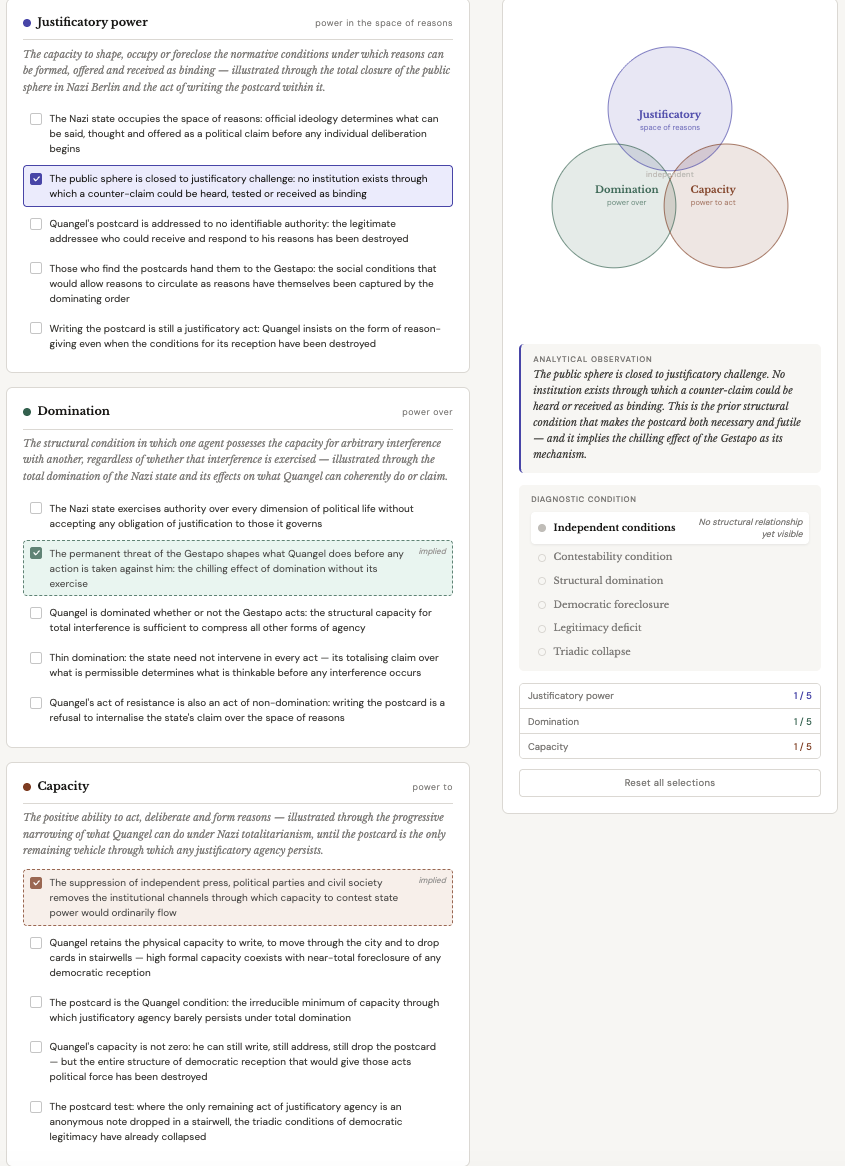
Running the triadic analysis makes that structure visible. Starting with capacity, Otto is not without it entirely. He can still write, move through the city and drop cards in stairwells. His physical capacity to act has not been reduced to zero. What has been reduced to near zero is the democratic infrastructure through which capacity becomes politically meaningful: independent media suppressed, political parties dissolved, civil society destroyed, legal institutions replaced with instruments of terror. The institutional channels through which the capacity to contest state power, what Diamond and Morlino call vertical accountability, would ordinarily flow have been systematically removed (Diamond and Morlino, 2004, p. 25). What remains is the postcard, the irreducible minimum of capacity through which justificatory agency barely continues. That Otto believes it persists at all is itself significant. His assessment of what remains is not independent of the noumenal conditions but shaped by them: what Forst describes as the capacity of noumenal power to determine what agents understand themselves entitled to demand within a given normative order (Forst, 2017, p. 42). For Otto, his space of reasons is largely closed off, reducing his capacity to act through the dominating structure he finds himself in, 'the coercion (Zwang) and the threat of violence (Gewalt), forms of power that rob the subjugated' (Forst, 2024, p. 187). Otto reasons within the only justificatory space the regime has left him, which is what makes the postcard analytically revealing. The postcard is what capacity looks like when domination and the foreclosure of the space of reasons, the realisation of noumenal power, have done their work. It is the floor: the point below which the agent's capacity to act has been so reduced by domination that justificatory agency cannot be sustained without being extinguished entirely. Pettit's account of freedom as non-domination supports this picture: freedom depends on reducing others' capacity to interfere and the ability to resist domination is itself tied to the agent's retained capacity to act (Pettit, 1997, pp. 66–67). Above the floor, however minimal the capacity that remains, the agent can still insist on the form of reason-giving. Below it, there is no act left through which that insistence can be expressed. Otto is at the floor and the postcard is the evidence of it.4
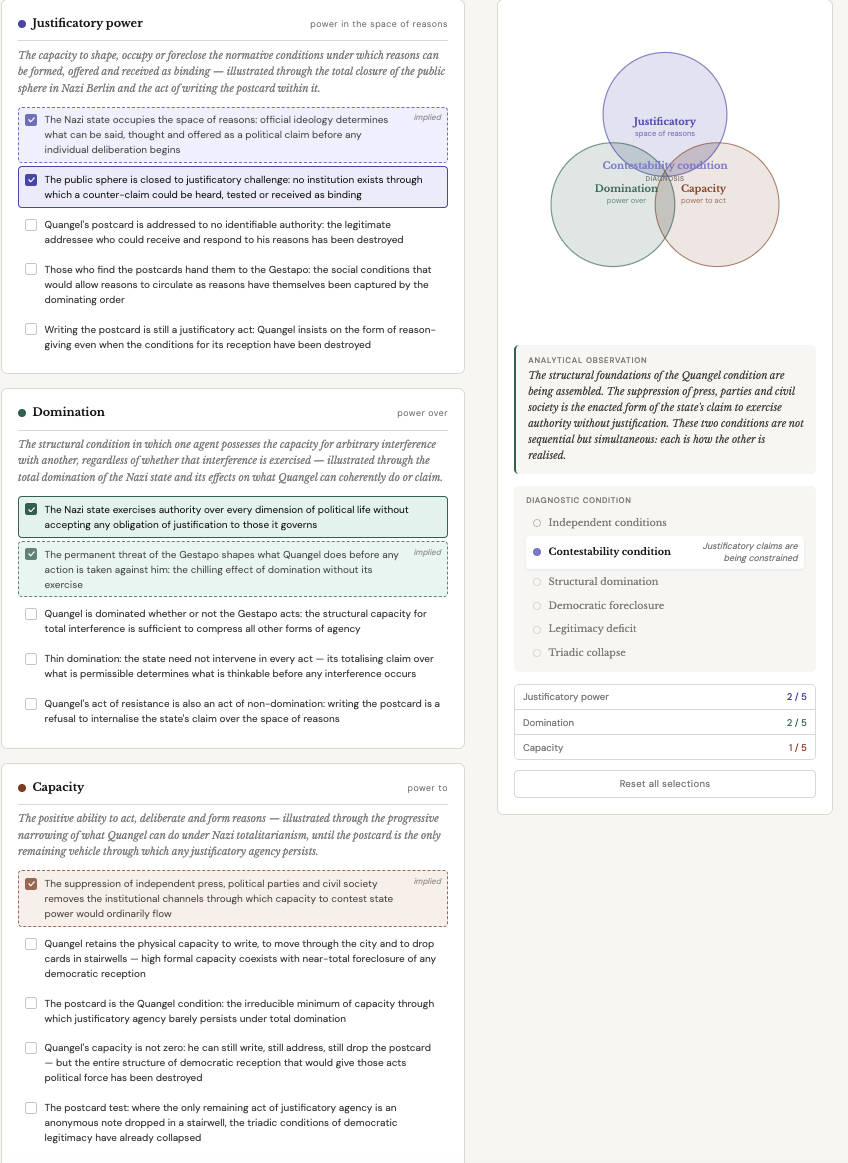
That structural force at this stage is domination. The state exercises authority over every dimension of political life without accepting any obligation of justification to those it governs. Domination, on Pettit's account, requires that one agent possesses sufficient capacity to interfere arbitrarily in another's choices, whether or not that interference is ever exercised (Pettit, 1997, pp. 52–53). Domination need not be exercised to produce its effects. The Gestapo need not act against Otto in every moment for domination to be fully operative — the 2 year time span between initial action and execution supports that. The possibility of interference is sufficient to shape what he can do and demand before any agent acts against him. This structural presence does not only threaten. It compresses what Otto understands himself capable of doing before any coercive act occurs. This is the condition in its sharpest form: Otto's act of dropping a postcard is already shaped by the knowledge of what finding one means and by what those who encounter his cards will likely do. The architecture of occupation has determined Otto's possibilities before he picks up the pen. Domination operates not only through its physical application, actual arrest, but through its structural presence: the odds of being arrested and the outcome of that. Those who find the postcards hand them to the Gestapo not because they are individually ordered to in each instance but because the structural conditions of occupation have already determined that this is what finding a postcard means. Following Hayward, structural power works not only through but also around human cognition: institutionalised conditions shape action regardless of what individuals consciously believe or endorse (Hayward, 2018, p. 61). The fear the object carries is itself a product of the dominating structure. The structure has already encoded what finding a postcard means before any individual arrives at the moment of decision. That encoding is domination operating: not through force or fear alone, but through the prior determination of what the situation itself requires.
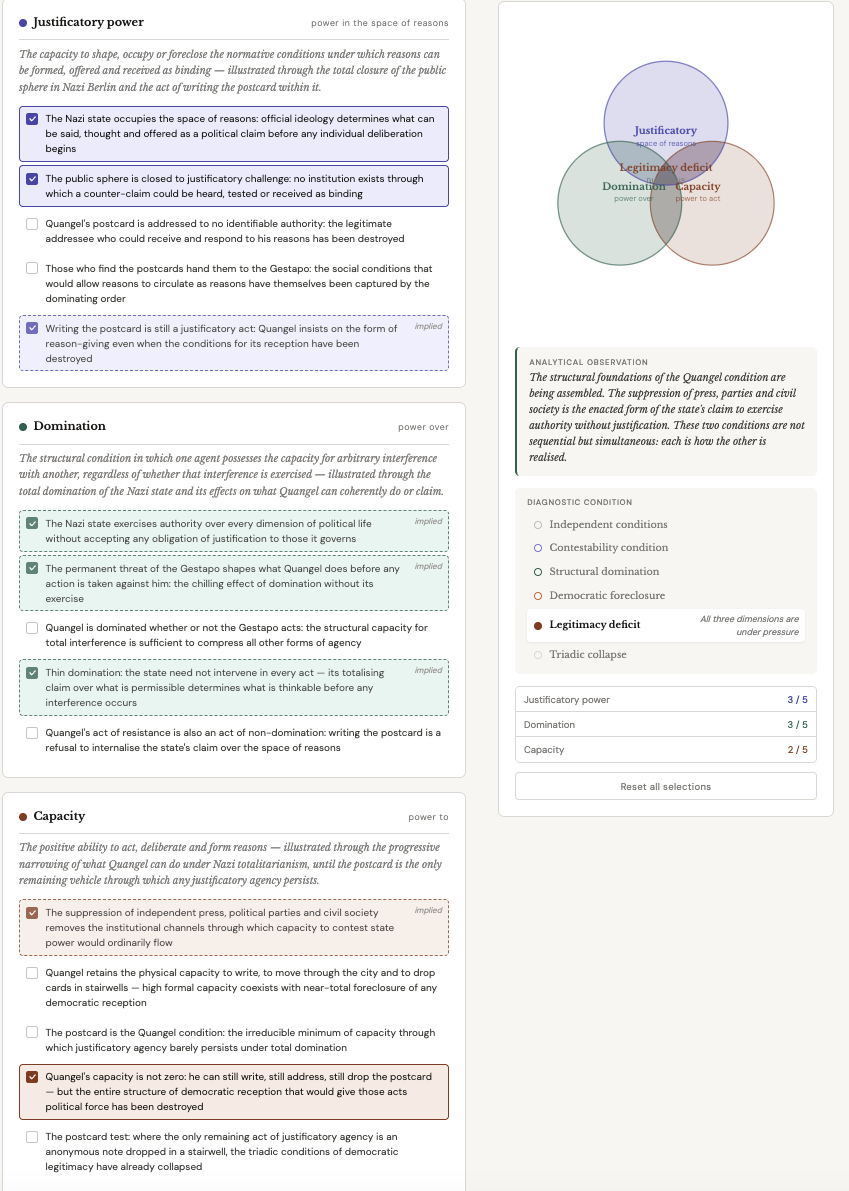
The space of reasons is sealed. Official ideology determines what can be said, thought and offered as a political claim. The legitimate addressee who could receive and respond to Otto's reasons has been destroyed, replaced by a charge of treason. Those who encounter the postcards cannot receive them as justificatory claims requiring response. They experience them as danger. The social conditions that would allow reasons to circulate as reasons have themselves been captured by the dominating order. Otto's postcard is addressed to no one capable of receiving it as such. It is, in Dean's formulation, counted, collected, numbered, filed by the Gestapo, but not heard (Dean, 2005, p. 60). The performance of participation is present but democratic substance has been architecturally removed.

What the triadic analysis reveals is how each power domain is acting on the others. Domination shapes capacity: the structural presence of the Gestapo compresses what Otto can do before any interference occurs. Capacity shapes the space of reasons: the reduction of available action to the postcard determines the outer limit of what justificatory claim can even be attempted. Where the space of reasons has been sealed, domination acquires a self-concealing character: the conditions under which it could be identified, named and challenged as domination have themselves been removed. Justificatory conditions remove the prospect of domination being challenged, the act of challenging that would expose it. This self-concealing character is not a feature of any single vertex but an emergent property of the triadic interaction, coming into force when justificatory power operates at its most complete in combination with domination and the compression of capacity.
This co-constitutive dynamic also pre-empts a possible misreading of the triadic model. One might object that in the Berlin scenario it is domination and capacity-reduction that do the real work and that the noumenal is simply a consequence of the other two. The triadic account challenges this. The democratic significance of what happens to Otto, why it matters as a failure of democratic conditions rather than just political oppression, depends on the justificatory frame. Without it, the postcards are a gesture of futile courage in the face of brutal power. Within it, they are the last act of a citizen asserting his standing as a normative authority in a space that has been architecturally sealed against him. He insists on the form of reason-giving even when the conditions for its reception have been destroyed. That insistence is itself a justificatory act, no matter how minimal or blind it may look. It is the reason the postcard is not merely a symbol of resistance but a precise illustration of what justificatory agency looks like at its irreducible minimum, the almost blind of Forst.

Otto's situation is a boundary marker as much as a thought experiment. It establishes the triadic structure at its extreme so that less extreme configurations become analytically legible. The inversion is already visible in contemporary democratic life.
The United States provides one of the clearest current illustrations. The V-Dem Democracy Report 2026 records an unprecedented deterioration: within a single year the USA's Liberal Democracy index score fell by 24 percent, dropping from 20th to 51st place globally, with freedom of expression reaching its lowest level since the end of the Second World War (Nord et al., 2026, p. 8). Running the triadic analysis against this data reveals what the index alone does not show.
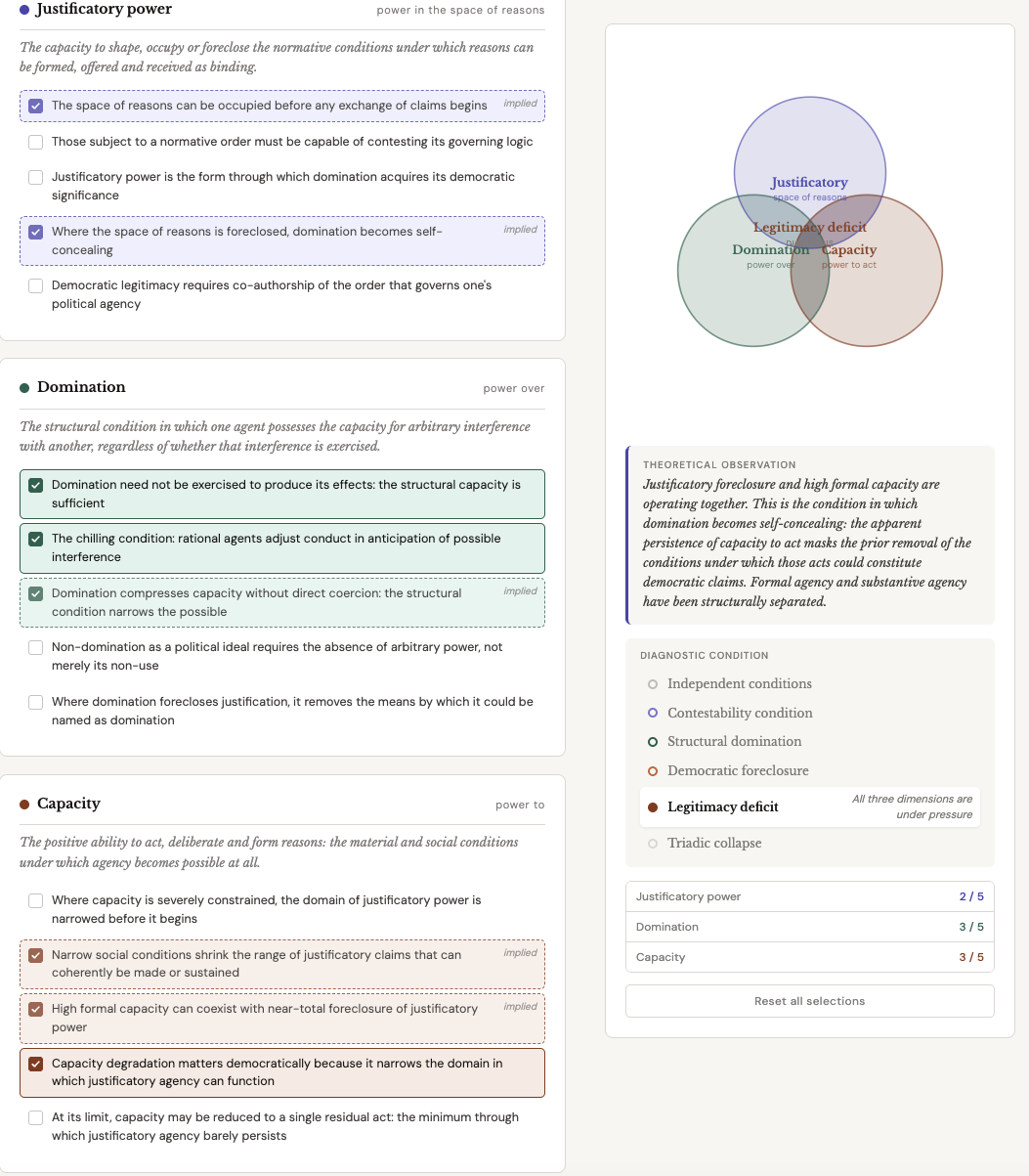
Capacitive power remains formally high. Elections are held, citizens organise, formal rights of participation still persist. The V-Dem data confirms this, the electoral democracy score has not collapsed in the way the liberal democracy score has. Dominating power is operating not through overt coercion but through executive aggrandisement and the structural dismantling of accountability institutions: weakening of checks and balances, interference in judicial independence, increased concentration of power in the executive. The structural capacity for interference is sufficient. It need not be exercised in every instance to shape what citizens and institutions understand themselves capable of demanding. Justificatory power is being systematically narrowed. Sustained attacks on media freedom removes the epistemic conditions under which political claims can be formed and circulated; weakening of courts removes the institutional addressees through which those claims could be received and acted upon. The space of reasons is not sealed to the extent it was for Otto. However, it is being progressively occupied. As the model's theoretical observation identifies, formal agency and substantive agency have been structurally separated. The apparent persistence of capacity to act masks the prior removal of the conditions under which those acts could constitute democratic claims. The triadic configuration is not the same as it was for Otto. Currently, it is its early inversion: formal capacity intact, domination operating structurally, the space of reasons under sustained architectural pressure. The US case illustrates what the triadic model can do that V-Dem alone cannot. The index records the outputs of democratic deterioration. The triadic model identifies the structural configuration that produces them and in doing so reveals where the democratic harm originates. An interactive version of the triadic model allowing exploration of this and other configurations is available at https://leviathan.website/tripower/triPower.html.5
This paper began with a challenge: that the critics of Forst's noumenal power claim identify genuine limitations that cannot be dismissed. McNay is right that a transcendental principle risks insulation from reflexive critique. Lukes is right that a cognitivist account cannot explain how power secures compliance outside the space of reasons. Hayward is right that structural power operates around cognition as well as through it. These are not minor objections and are voiced by others. They are substantive challenges to the foundations of a framework this paper has built upon.
The response has not been to defend Forst as he stands. A purely transcendental noumenal power cannot account for the structural variation between different political contexts, for why the same principle operates differently in a functioning democracy, an autocratising state and a totalitarian regime. The challenge has been to take the critics seriously enough to let their objections assist in creating an expansion rather than a retraction. McNay's challenge motivates the constructivist reframing, grounding the noumenal priority claim in what democratic legitimacy requires rather than in a principle prior to social life. Lukes's challenge motivates the domination vertex, supplying the structural account of how the space of reasons comes to be occupied that Forst's framework needs but does not provide. Hayward's challenge motivates the structural and capacity dimensions, showing how domination and capacity-reduction operate around and below the space of reasons before any justificatory relationship begins. Together, the three critics do not refute noumenal power; they do acknowledge that Forst is bringing something to the power debate. They make it stronger by forcing it to account for the structural conditions of its own operation.
The triadic model that emerges from this engagement is not a replacement for Forst's noumenal priority claim. It takes a constructivist approach to that claim, placing the noumenal priority within the structural conditions that give it operational force. Justificatory power retains its democratic priority not because it is causally primary but because it is the dimension through which the democratic significance of the other two is constituted and through which both can become self-concealing. Strip out the justificatory frame and what remains is an account of harm or structural constraint, but not a specifically democratic analysis.
The analytical value of the model is demonstrated by what it can do that existing approaches cannot. The contrast between Otto at high triadic convergence and the United States at partial convergence is not just a difference of degree. It is a difference of kind, two structurally distinct configurations of democratic harm, each requiring a different analytical response. The V-Dem index records the outputs. The triadic model identifies the structural conditions that produce them and in doing so reveals where the democratic harm actually originates.